Governance
The Environmental Management Strategy Board formulates strategies, policies, and targets for the Group's environmental management and climate change response. Based on this policy, the Environmental Management Promotion Committee promotes effective action plans for each division and group company and conducts environmental education to raise the environmental awareness of each employee. The Risk Management Committee deliberates on matters related to climate change risk management, and the Internal Audit Department conducts environmental audits of each department and each affiliated company. The Board of Directors monitors setting climate-related targets and their progress by receiving reports and providing appropriate advice from the Environmental Management Strategy Board.
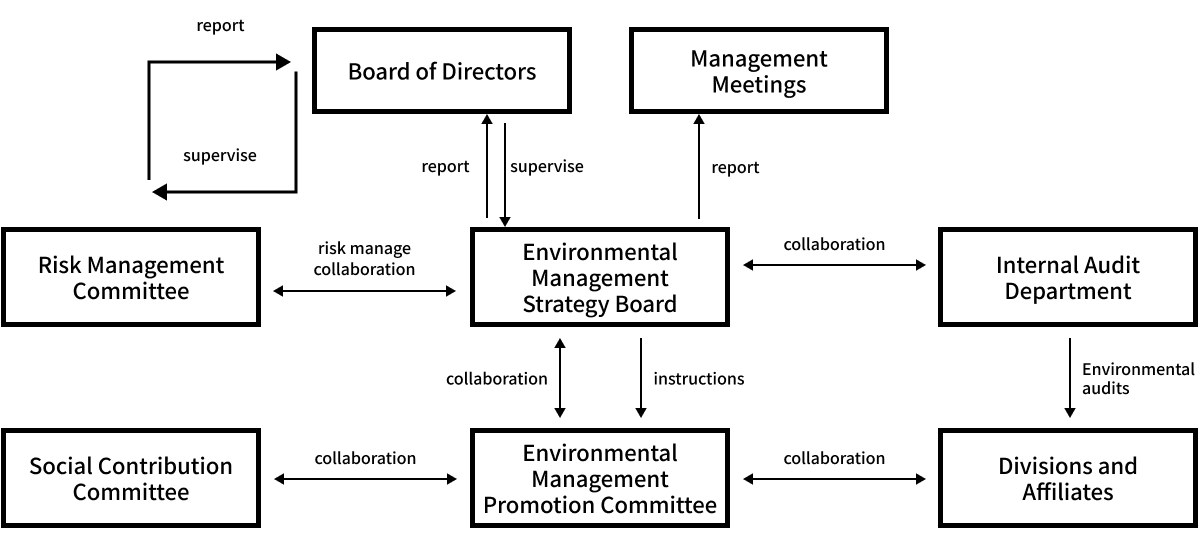
| Board of Directors |
Oversight of climate change response |
At least once a year |
Environmental Management Strategy Board
|
Determination of policies, strategies and targets for environmental management and climate change response Officer in charge: Director, Vice President and Executive Officer, General Manager of Pasona Way General Headquarters |
At least once a month |
Strategies
The Group analyzed risks and opportunities for 2030 based on several climate change scenarios (1.5–2℃ and 4℃ global increases). The scenario analysis is based on reports issued by the Intergovernmental Panel on Climate Change (IPCC), the International Energy Agency (IEA), and Japan's Ministry of the Environment, and other organizations. The process of analysis and the main risks and opportunities identified in the scenario analysis are as follows.
Analytical Process

Risk / Opportunity Items
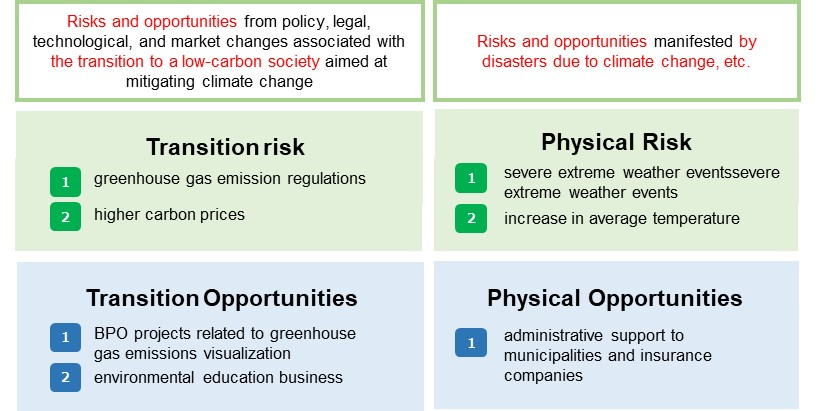
For each risk and opportunity identified, we drew up specific scenarios and examined the financial impact on our business, quantitatively and qualitatively. As a result, the major risks and opportunities identified by the Group through this scenario analysis and our policy for dealing with them are as follows. No significant risks affecting the business were identified. We will continue to review our assessments and enhance information disclosure.
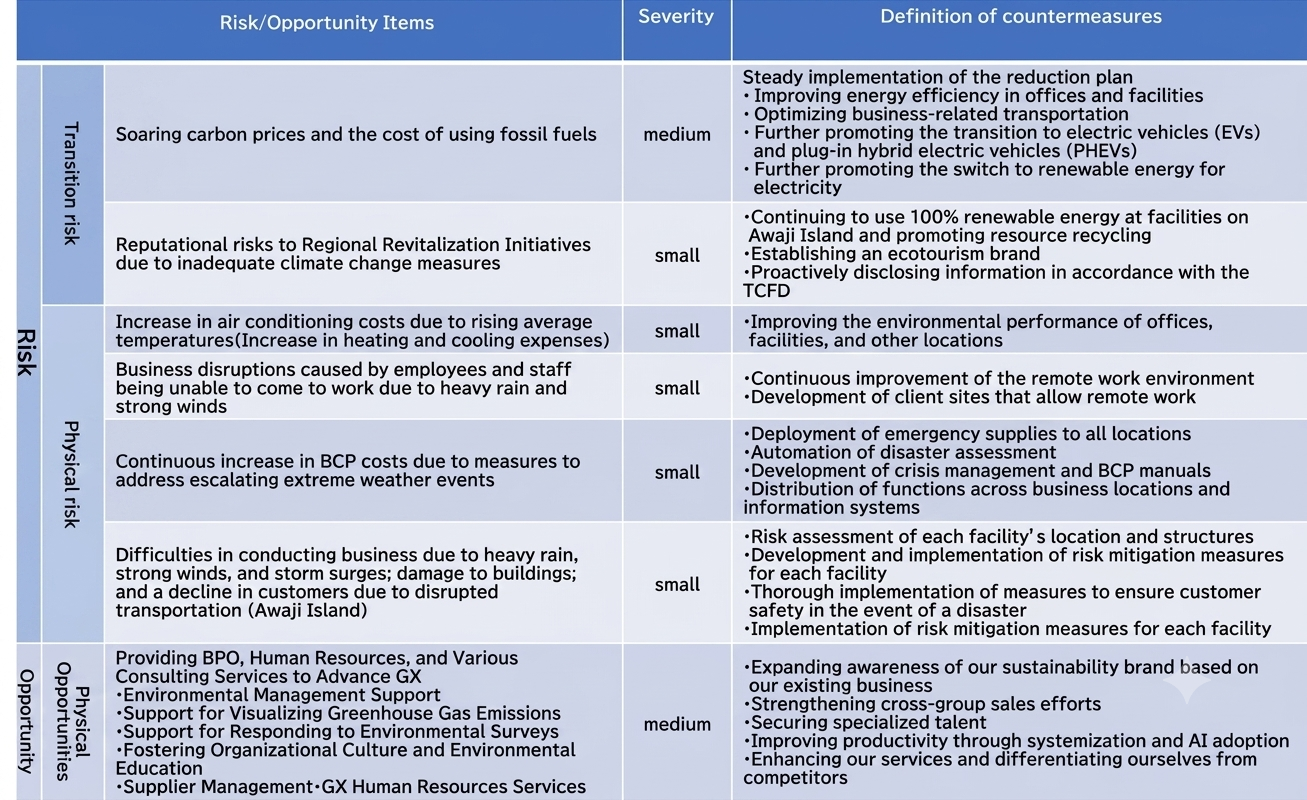
Strategies (Opportunities)
As the movement toward decarbonization accelerates in Japan and abroad, listed companies are required to disclose climate-related financial information and take actions to achieve carbon neutrality, including in their supply chains. However, many companies lack not only the know-how to visualize greenhouse gas emissions, but also the resources to perform the complicated tasks involved. Another challenge is educating employees about the SDGs.
The Group offers diverse services to support environmental management for companies, municipalities, and others pursuing GX (Green Transformation), including consulting and BPO solutions for disclosing climate-related risks and reducing greenhouse gas emissions.
1. Environmental management support and sustainability human resources development
Pasona Sustainability Inc. provides visualization of greenhouse gas emissions, energy‑saving diagnostic services, greenhouse gas reduction solutions, and J‑Credit purchasing agency services. It also supports companies in advancing their Sustainability Transformation (SX) by providing training programs to develop sustainability human resources.
2. Support for sustainable management by professional human resources
Pasona JOB HUB Inc. provides professional advisors who are well-versed in various fields to support the formulation of SDGs and ESG management strategies, planning of circular economy business strategies, and establishment of recycling-oriented supply chain business models to promote sustainable management.
3. Energy-Saving Consulting Services to Reduce Environmental Impact
Pasona Nihon Somubu Co., Ltd.'s "Energy Conservation Consulting Service" provides comprehensive support for resolving corporate environmental issues, from the visualization of greenhouse gas emissions to initiatives for decarbonization, leveraging our expertise in facility management. Based on the results of the simplified energy efficiency and conservation diagnosis, we will conduct a detailed analysis, formulate improvement measures, estimate their effects, and support the implementation of measures to resolve issues.
4. Sustainable training program for co-creation, circulation, and diversity
Pasona Agri-Partners Inc. offers training programs on Awaji Island, Hyogo Prefecture, for companies, organizations, and educational institutions to learn about "SDGs" such as those involving food safety and the natural environment. The program offers agricultural experiences to learn about soil cultivation, food safety, and production processes, as well as classroom training to learn about issues related to abandoned farmland and de-plasticized materials, with approximately 3,000 participants in the fiscal year ending May 31, 2026.
Risk management
The Group has established Risk Management Regulations and Risk Management Committee as the overarching body responsible for risk-related matters to prevent crises that could have serious impact on management and to minimize losses if such crises should occur.
Risks due to climate change are identified by the Environmental Management Strategy Board, where relevant laws and regulations and natural disasters that can affect business are discussed and integrated into the overall risk‑management process through the Risk Management Committee.
In addition, the Board of Directors is regularly informed of the details of these measures, the status of response is monitored, and progress is managed and reviewed. We are building a management system for climate change risk.
Indicators and Targets
The Group calculates and measures greenhouse gas emissions from its business activities and has set a reduction target of "achieving carbon neutrality* in FY2030". In addition to actively using electricity derived from renewable energy sources in our offices and the facilities we operate, we are also switching to electric and hybrid vehicles for company vehicles.
(*) "Scope 1" and "Scope 2" of greenhouse gas emissions from the Group's business activities are covered.
The following table shows greenhouse gas emissions associated with business activities. (Unit: t-CO2)
| Item |
Fiscal year 2024 (ending May 31, 2025) |
Fiscal year 2025(ending May 31, 2026)
|
| Scope 1 + Scope 2 (Market‑based method) total |
6,108 |
6,473 |
| Scope 1 |
2,094 |
2,397 |
| Scope 2 (Market‑based method) |
4,015 |
4,076 |
| Scope 2 (Location‑based method) |
6,691 |
6,718 |
| Scope 3 total |
128,848 |
119,092 |
| Category 1 (Purchased goods and services) |
92,680 |
76,464 |
| Category 2 (Capital goods) |
8,629 |
18,052 |
Category 3 (Fuel- and energy-related activities
(not included in Scope 1 or Scope 2) |
1,633 |
1,738 |
Category 4 (Upstream transportation and
distribution) |
12,360 |
11,832 |
| Category 5 (Waste generated in operations) |
1,240 |
1,851 |
| Category 6 (Business travel) |
5,699 |
2,761 |
| Category 7 (Employee commuting) |
6,398 |
6,185 |
| Category 8 (Upstream leased assets) |
210 |
210 |
| Grand total |
134,956 |
125,565 |
Notes:
1 The scope of the Group includes the results of the Company on a non-consolidated basis and the results of the 11 consolidated companies that account for large percentage of consolidated net sales.
2 Actual results may vary due to the refinement of the aggregation method.
3 All greenhouse gases emissions figures are calculated in accordance with the GHG Protocol.
To reduce greenhouse gas emissions, we are implementing initiatives such as using 100% renewable energy at our restaurants and tourism facilities on Awaji Island, composting food waste using large-scale composters, and decarbonizing our company vehicles. We are also working to reduce the environmental impact of our overall business operations through measures such as installing energy-efficient equipment and promoting paperless operations. By expanding the use of renewable energy and promoting resource recycling, we aim to realize a decarbonized society.