Basic Stance Concerning Corporate Governance
Ever since its founding, Pasona Group has promoted diversity based on a clear and transparent corporate philosophy of providing “Solutions to Society's Problems" and has built various forms of social infrastructure enabling anyone to freely select the jobs they like and gain opportunities to work.
Pasona Group's job is to harness the potential of the individual. In other words, to coin a phrase, the job is to: "Life Produce"; to support the creation of a comfortable lifestyle for people everywhere. Creating a society in which everyone can design their own lives of abundance according to their ways of working that suit their own lifestyles—those who consistently maintain a strong will and seek to reintegrate into society, those who seek the challenges of a new life, who boldly tackle their life's goals—this is the corporate social responsibility (CSR) of the Pasona Group. In order to meet its social responsibilities, Pasona Group has laid forth "The Pasona Group Corporate Behavior Charter." All executives and employees from Pasona Group, from top management downward, are required to have a correct understanding of this charter, as it consists of action guidelines.
It is part of the Pasona Group’s basic corporate mission to accomplish continuous enhancement of corporate value for its stakeholders (interested parties). To do so, we will boost corporate governance in harmony with the spirit of the “Corporate Governance Code” as stated in the Listing Regulations of the Tokyo Stock Exchange, considering this to be an important management issue. We will achieve medium- to long-term enhancement of corporate value through swift and bold decision-making while also ensuring the effectiveness of management oversight and management transparency.
Corporate Governance Structure
Organizational Chart
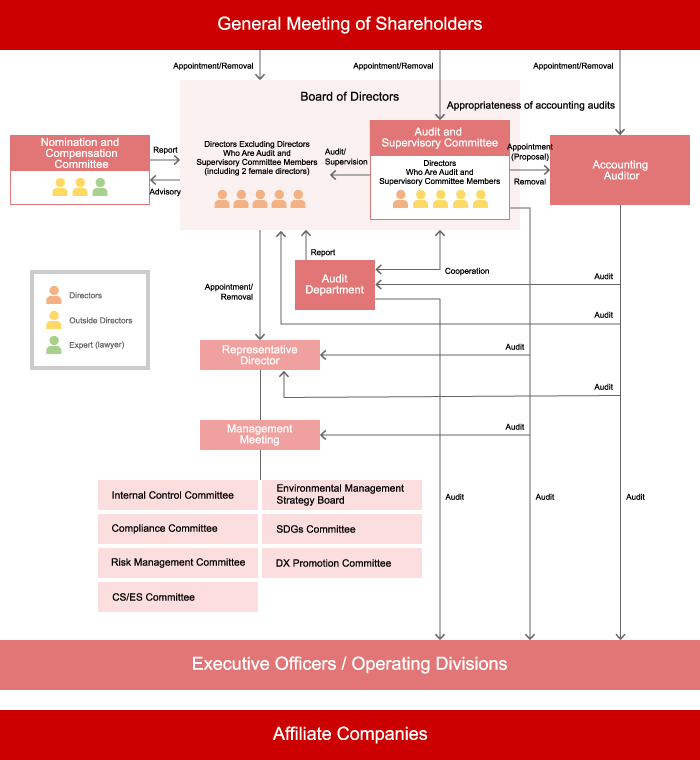
The Company has adopted a governance structure as a company with an Audit and Supervisory Committee in order to strengthen the audit and supervisory functions of the Board of Directors, enhance corporate governance, and improve management efficiency by delegating authority to Directors to enable swift decision-making. Our corporate governance structure is as follows, and we believe that this structure enables us to respond swiftly to changes in the business environment and execute operations in a timely and appropriate manner.
The Company has also introduced an Executive Officer system to expedite decision-making by delegating authority for individual operational decisions to management including the Representative Director, and Executive Officers; the details of such delegations are clearly specified in the organizational regulations and other documents established by resolution of the Board of Directors.
Corporate Governance Initiatives
| Date |
Initiative |
| October 2015 |
Introduction of a performance-based stock compensation plan |
| January 2016 |
Disclosure of criteria for determining the independence of Independent Outside Directors |
| February 2016 |
Introduction of an evaluation of the effectiveness of the Board of Directors |
| December 2016 |
Introduction of a group performance evaluation system |
| August 2017 |
Transition to a company with an Audit and Supervisory Committee |
| October 2020 |
Launch of exchange meetings between Outside Directors and Executive Officers |
| June 2021 |
Establishment of the Nomination and Compensation Committee |
| July 2021 |
Formulation of a skills matrix for Directors |
| July 2021 |
Endorsement of the TCFD |
| April 2022 |
Transition to the Prime Market |
| August 2023 |
Increase in the number of Outside Directors to 4 (40%) |
| July 2024 |
Disclosure of the compensation policy |
| July 2025 |
Introduction of a restricted stock compensation plan for Directors and other executives |
Board of Directors
The Board of Directors serves as the body for supervising the overall management of the Company and is the highest decision-making authority following the General Meeting of Shareholders. It is composed of Directors who are not members of the Audit and Supervisory Committee who have a term of one year, along with Directors who are members of the Audit and Supervisory Committee who have a term of two years.
The Board of Directors makes decisions on important matters concerning the Company and its group companies such as M&A, organizational restructuring, the disposal or acquisition of significant assets, and large-scale investments and financing, in accordance with laws and regulations, the Articles of Incorporation, and the Board of Directors’ Rules established by resolution of the Board. As of the date of the Corporate Governance Report, the Board of Directors is comprised of five Directors (three men and two women) who are not Audit and Supervisory Committee Members, and five Directors (all men) who are Audit and Supervisory Committee Members. Of these, four Directors (all men) are Independent Outside Directors who are Audit and Supervisory Committee members. Also, by making 40% of the Directors into Independent Outside Directors, the monitoring function of the Board of Directors has improved. The CEO serves as the Chairperson of the Board of Directors.
Evaluation of the Effectiveness of the Board of Directors
The Company conducts an annual evaluation of the effectiveness of the entire board of directors with the aim of further improving the governance functions of the board. The evaluation methods and results are reported to the Board of Directors, and the Company reviews the operation of the Board of Directors and other related matters as necessary to further enhance its effectiveness. Please refer to the following for an overview of the evaluation and its results.
The evaluation method and summary of the evaluation results are as follows.
Results of the Effectiveness Evaluation of the Board of Directors for FY2025
Event Record and Attendance Rate (FY 2025)
The Company's Directors hold regular meetings of the Board of Directors at least once a month and extraordinary meetings as necessary. The Board of Directors held 17 meetings during the fiscal year under review, and each director had a 100% attendance rate.
Matters to be deliberated and reported by the Board of Directors
Specific matters to be deliberated and reported during the fiscal year under review are as follows:
- Medium- to Long-term Management Strategy of the Group
- New Business Strategies (Including New Business)
- M&A and Organizational Restructuring
- Financial Results, Business Performance, and Financial Strategies
- Budget Management
- Acquisition of Assets and Investments (Including Fixed Assets)
- Transactions involving conflicts of interest
- Risk Management
- Compliance
Management Meeting
A Management Meeting is held twice a month, in general, so as to allow decisions concerning important matters affecting the entire Company to be made quickly and efficiently. As of the date of submission of the Annual Securities Report, the Management Meeting is composed of five Directors who are not Audit and Supervisory Committee Members (Mr. Hirotaka Wakamoto, Mr. Shintaro Nakao, Ms. Junko Fukasawa, Ms. Kinuko Yamamoto, and Mr. Makiya Nambu), one full-time Audit and Supervisory Committee Member (Mr. Kazufumi Nomura), and 14 titled Executive Officers (Ms. Yuko Nakase, Mr. Akira Kamitomai, Mr. Hajime Kono, Mr. Motoyoshi Takagi, Ms. Takako Yagi, Mr. Takuji Matsumura, Ms. Kaori Shindo, Ms. Yukari Ohinata, Ms. Mari Kanazawa, Ms. Misako Nakata, Ms. Azusa Mitsuda, and Mr. Koichi Itabashi, Mr. Tomokazu Okada, Mr. Hiroshige Sadamatsu). The CEO serves as the Chairperson of Management Meetings.
Audit and Supervisory Committee
The Audit and Supervisory Committee of the Company consists of five members: one full-time director and four Outside Directors (all serving two-year terms). The Audit and Supervisory Committee members monitor the Company’s overall state of business execution through a variety of audit activities. They attend the Board of Directors meetings and other important meetings, receive business reports from Directors, conduct accounting audits for affiliated companies, review important documents and records, examine the appropriateness of the auditing method employed by the accounting auditor, and hold periodic meetings with the Audit Department and the Group Internal Audit Department. The Committee’s audit findings are reported to the Board of Directors either verbally or in writing, and it advises or makes corrective recommendations where appropriate. The personnel of the Audit Department assist in the duties of the Audit and Supervisory Committee.
Outside Directors
In selecting Outside Directors, we adhere to the Company’s basic policy on Director appointments and choose individuals who possess expertise not only in management, finance, accounting, and legal matters but also in the business areas of the Group, with the aim of achieving sustainable growth and enhancing corporate value over the medium to long term.
Mr. Haruo Funabashi, Mr. Kazuo Furukawa, Mr. Ryohei Miyata, and Mr. Yutaka Atomi are classified as Independent Outside Directors, and we believe they will provide opinions from an independent perspective at Board of Directors.
Reasons for the Appointment of Outside Directors
Director Funabashi
Mr. Funabashi has extensive experience working in administration and as an Outside Director of a listed company. He also has the broad insight he has gained during the course of his professional career, together with his independent standpoint. We believe he is well-suited to serve as an Outside Director on the Audit and Supervisory Committee, as he can apply the broad perspective cultivated throughout his career to oversee our company’s management and, from an independent standpoint, is expected to strengthen the Board of Directors’ decision-making, auditing, and supervisory functions.
Director Furukawa
Mr. Furukawa has served as a director, president and COO of Hitachi, Ltd., and possesses knowledge in technical fields such as information telecommunication. He also has extensive experience in working in corporate management. We believe he is well-suited to serve as an Outside Director on the Audit and Supervisory Committee, as he can apply the broad perspective cultivated throughout his career to oversee our company’s management and, from an independent standpoint, is expected to strengthen the Board of Directors’ decision-making, auditing, and supervisory functions.
Director Miyata
Mr. Miyata has won many awards as a metal craftsman and has served in positions such as Commissioner-General of the Agency for Cultural Affairs, playing a leading role in Japan’s cultural administration. He possesses the broad knowledge in the fields of culture and arts—which are indispensable to our regional revitalization initiatives—as well as extensive experience in university administration. We believe he is well-suited to serve as an Outside Director on the Audit and Supervisory Committee, as he will apply the broad perspective cultivated through his career to oversee our company’s management and, from an independent standpoint, is expected to strengthen the Board of Directors’ decision-making, auditing, and supervisory functions.
Director Atomi
Mr. Atomi has broad knowledge as a medical scientist, which is indispensable for the Company's healthcare business, and abundant experience as a president and in the management of a university. We believe he is well-suited to serve as an Outside Director on the Audit and Supervisory Committee, as he will apply the broad perspective cultivated through his career to oversee our company’s management and, from an independent standpoint, is expected to strengthen the Board of Directors’ decision-making, auditing, and supervisory functions.
Criteria for Determining the Independence of Independent Outside Directors
The Company considers that an Outside Director or an Outside Director candidate is “independent” if he or she satisfies the following independence criteria set forth by the Company:
- No relative within a second degree of kinship is or has been an executive director of the Company or any of its subsidiaries.
- No business transaction exceeding 2% of the Company"s consolidated net sales was conducted in the last three business years between Pasona Group and the company where he or she currently serves in the capacity of executive officer or employee.
- He or she never received compensation exceeding 10 million yen on an annual basis directly from Pasona Group in the last three business years for services rendered as a legal, accounting, or taxation professional or as a consultant (except for payments in the form of compensation for services rendered as the Company"s officer or in the form of fees paid to the organization or firm of his or her affiliation).
- He or she is not an executive officer of an organization that has received donations from Pasona Group in excess of 10 million yen on an annual basis in the last three business years.
Nomination of Directors
Criteria and Procedures for the Nomination and Election of Directors
The basic policy is to select candidates who are superior in personality, possess insight suitable, and who are desired as part of the Board of Directors, taking into consideration the balance and diversity of knowledge, experience, and ability of the Board of Directors as a whole. For Outside Directors, the Company particularly looks for persons with strong expertise in management, finance, accounting, law, or other disciplines in addition to the Group’s business areas, so as to drive the sustainable growth of the Company and to elevate its corporate value over the medium and long term. Prior to the official nomination of candidates by a resolution of the Board of Directors, the Nomination and Compensation Committee, which is composed of a majority of independent Outside Directors who meet the Company’s criteria for independence, submits a report on prospective candidates based on the above basic policy to the Board of Directors.
Mr. Haruo Funabashi, Mr. Kazuo Furukawa, Mr. Ryohei Miyata, and Mr. Yutaka Atomi, who are qualified as independent Outside Directors, are expected to provide invaluable insight and opinions from an independent perspective at the Board of Directors meetings.
If, in the opinion of the Company, a director fails to sufficiently fulfill his or her function, the Nomination and Compensation Committee deliberates the dismissal before the matter is brought to the Board of Directors. After the Board of Directors reaches a decision, the issue is forwarded to the General Meeting of Shareholders for its approval.
Outside Directors regularly exchange opinions with executive officers, and Outside Directors who are members of the Nomination and Compensation Committee are able to recognize their qualities, including their traits and knowledge, and utilize these when nominating candidates for director.
Composition of the Nomination and Compensation Committee, etc.
To strengthen the fairness, transparency, and objectivity of procedures related to the nomination and compensation of Directors and enhancing corporate governance, the Company has established a voluntary Nomination and Compensation Committee as an advisory board to the Board of Directors that consists of a majority of independent Outside Directors who meet the Company’s independence criteria. The purpose of the Nomination and Compensation Committee is to deliberate on matters related to the nomination and dismissal of Directors, the selection and dismissal of representative Directors, and the selection and dismissal of executive Directors, as well as to decide on matters related to fixed compensation, restricted stock compensation, etc., for each individual Director who is not a member of the Audit and Supervisory Committee.
| 【Frequency of Meetings】 |
1meeting (FY 2025) |
| 【Attendance Rate】 |
100% (FY 2025) |
Director Skills Matrix
Skill Summary
Executive Compensation
Compensation Policy
(ⅰ) Basic Policy
Compensation should be at a level that ensures diversity on the Board of Directors and the hiring of global management personnel who have excellent traits and knowledge.
The compensation system should contribute to the sustainable growth of Pasona Group and to the medium- to long-term enhancement of corporate value.
The compensation determination process should be highly fair, transparent, and objective.
(ⅱ) Compensation Level Concept
The compensation level should be benchmarked according to third-party compensation surveys of listed companies in Japan.
The compensation level should be determined by taking into consideration the officer"s position, responsibilities, and level of contribution to the Company and should be reviewed according to changes in the external environment and the officer"s responsibilities, etc.
(ⅲ) Compensation System Concept
- The link between the compensation for Directors, etc., and the Company"s business performance and shareholder value should be clear in order to motivate the officers to make greater contributions to the Company"s medium- to long-term business performance and enhance corporate value.
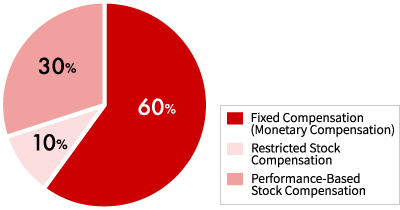
- Compensation for Directors (excluding Directors who are members of the Audit and Supervisory Committee) consists of fixed compensation (monetary compensation) and stock-based compensation. The stock-based compensation is comprised of restricted stock compensation designed to share value with shareholders and performance-linked stock compensation designed to enhance awareness of contribution to medium- to long-term performance and improve corporate value. As a general rule, the ratio of fixed compensation (monetary compensation) to stock-based compensation (restricted stock compensation + performance- based stock compensation) is designed to be 6:4.
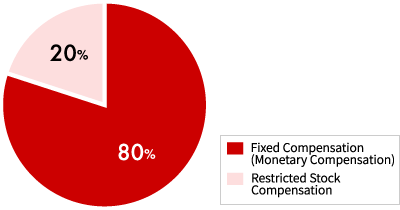
- Compensation for Directors who are members of the Audit and Supervisory Committee is structured in consideration of their role in overseeing the execution of business operations by other Directors, and consists of fixed compensation (monetary compensation) and restricted stock compensation as stock-based compensation. As a general rule, the ratio of fixed compensation (monetary compensation) to stock-based compensation (restricted stock compensation) is designed to be 8:2.
(ⅳ) Compensation Governance Concept
Compensation for individual Company Directors should be determined by the committee for nomination and compensation, consisting of a majority of independent Outside Directors who meet the Company"s independence criteria.
(Reference) Standard Model for Compensation Structure and Composition
Directors who are not members of the Audit and Supervisory Committee
Directors who are members of the Audit and Supervisory Committee
*The percentage of the total compensation amount accounted for by performance-based stock compensation is generally between 0% and 30% when performance targets are met.
The details of the resolution passed at the General Meeting of Shareholders regarding Directors’ compensation, the date of the resolution, and the number of Directors at the time of the resolution are as follows.
1) Compensation for Directors who are not members of the Audit and Supervisory Committee
2) Compensation for Directors Who are Members of the Audit and Supervisory Committee
Dialogue with Shareholders
We will actively communicate with our stakeholders, including shareholders and investors, and proactively disclose corporate information such as our management strategy, business activities, and financial condition, with due consideration for timeliness, fairness, accuracy, and continuity. This policy is published on our website as our “Disclosure Policy”.
- The Investor Relations Headquarters is responsible for communication with shareholders in general, with the executive officer in charge of the Investor Relations Headquarters exercising oversight.
- To enhance communication with shareholders, the head of the Investor Relations Headquarters works organically with the respective heads of departments related to finance and accounting, corporate planning, administration, legal, and other functions and of operating divisions to ensure prompt information-sharing and fact verification.
- Twice a year, the Company organizes presentation meetings for institutional investors and security analysts to discuss the Company"s interim and full-year results, in addition to individual meetings and interviews and small-group meetings, which are scheduled from time to time. The Company proactively communicates with shareholders and investors by posting news and information on the pages dedicated to investor relations on the Company"s website.
- The opinions and concerns voiced by shareholders while engaged in such dialogue as above are regularly reported to the board meetings.
- When communicating with shareholders, special care is taken to ensure compliance with the Company"s anti-insider trading regulations, which govern the Company"s handling of material facts. The Company refrains from making any comments regarding business results or answering any inquiries related to in the period from the day following the end of each quarter until the day of the financial results announcement, known as the “quiet period.”
Corporate Governance Report